




KEY TAKEAWAYS
- On May 14, 2026, the U.S. Supreme Court unanimously held in Montgomery v. Caribe Transport II, LLC that federal law does not preempt state freight broker negligent hiring claims when the theory of liability concerns motor vehicle safety.
- The Court did not rewrite preemption. Economic regulations of broker prices, routes, and services that have no safety tie remain preempted.
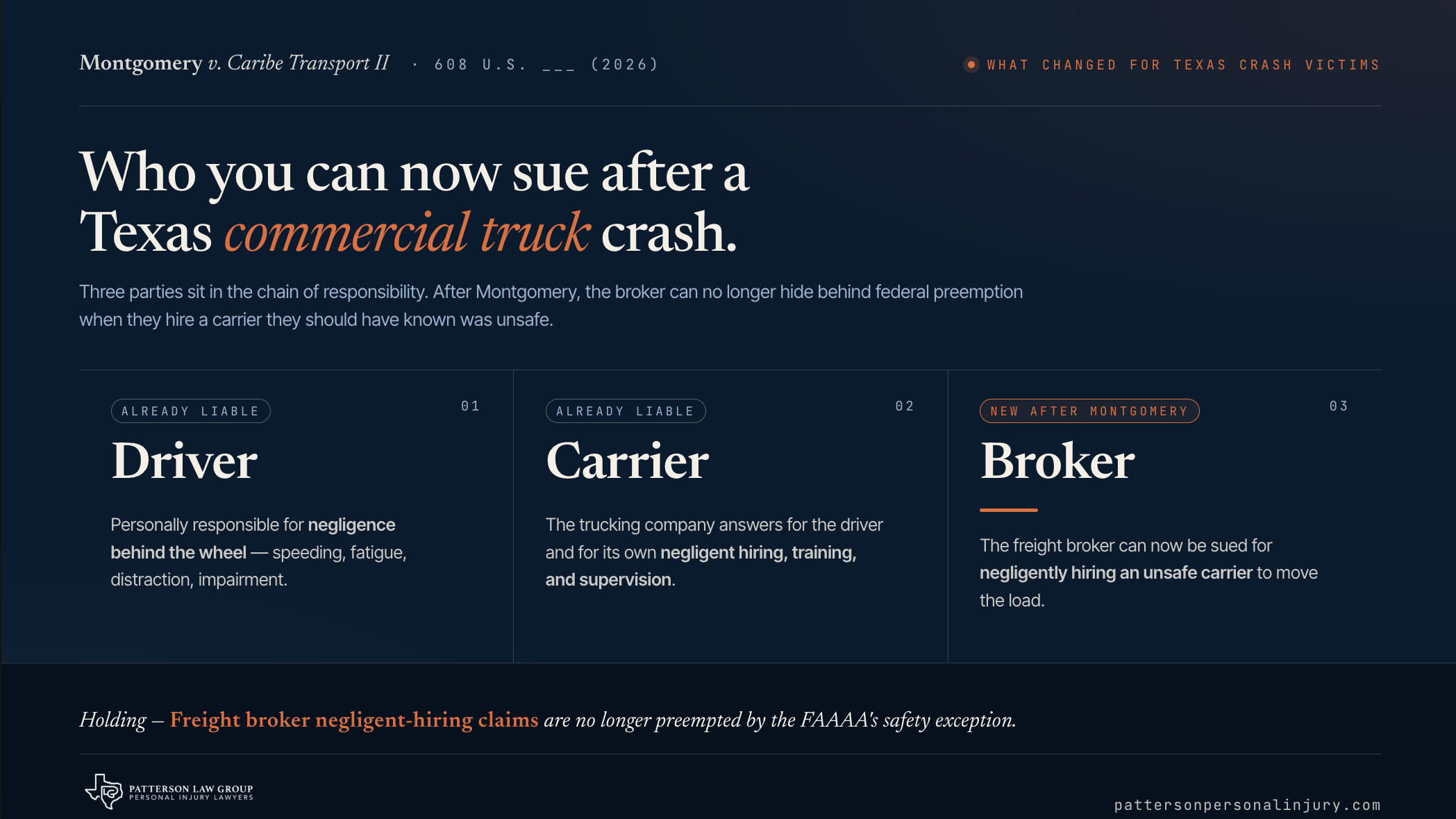
- Texas families injured in a truck crash can still sue the driver and the carrier — and, in cases where the broker put an unsafe carrier on the road, the broker too.
- For under-insured or judgment-proof trucking companies, the broker may finally be a defendant that can actually pay for the harm done.
For years, freight broker negligent hiring claims — lawsuits arguing that a broker put an unsafe trucking company on the road — were dismissed in many federal courts before they could even reach a jury. With today’s unanimous Supreme Court ruling, that defense is gone for the cases that matter most.
In a unanimous decision in Montgomery v. Caribe Transport II, LLC, 608 U.S. ___ (2026), the United States Supreme Court held that federal law does not preempt state-court freight broker negligent hiring claims when the theory of liability concerns motor vehicle safety. It is a significant win for truck crash victims and their families — and it should change how every broker in the country chooses which carriers to put on the road.
What Happened in the Case
Shawn Montgomery was stopped on the side of an Illinois highway when a Mack truck swerved off course and slammed into his rig. He lost a leg. The driver worked for a trucking company called Caribe Transport, which was operating under a “conditional” safety rating from the federal government — the Federal Motor Carrier Safety Administration had already flagged the carrier for deficiencies in driver qualifications, hours-of-service compliance, inspection and maintenance, and recordable crash rate.
The broker who arranged the load — C.H. Robinson, one of the largest freight brokers in the country — argued that a 1994 federal law called the FAAAA preempted Mr. Montgomery’s freight broker negligent hiring lawsuit. In plain English, the broker claimed it could not be sued in state court at all for choosing an unsafe carrier.
The Seventh Circuit Court of Appeals agreed with the broker. The Supreme Court reversed unanimously, 9-0.
What Does a Freight Broker Actually Do?
Brokers are the matchmakers of the trucking industry. When a company needs to move freight, it usually does not hire a trucking company directly. It hires a broker, and the broker finds a carrier to haul the load. According to the Supreme Court’s opinion, roughly 28,000 brokers arrange about a third of all freight shipped in the United States.
That is a lot of decisions about which trucks end up on the highway next to you — and a lot of opportunities for freight broker negligent hiring to put unsafe carriers on the road.
How Freight Broker Negligent Hiring Claims Now Survive Preemption
Before Montgomery, courts in some parts of the country said freight brokers were essentially untouchable. If a broker put an unsafe carrier on the road, the people that carrier hurt had no way to hold the broker accountable.
The Supreme Court rejected that idea. Writing for the unanimous Court, Justice Barrett held that even assuming the FAAAA would otherwise preempt the claim, the statute’s “safety exception” saves it. That exception preserves a state’s authority to regulate safety “with respect to motor vehicles.” A freight broker negligent hiring claim “concerns” the trucks that end up on the highway, and that is enough to bring the claim within the safety exception.
“This is not a windfall. It is a duty of reasonable care.”
It is worth being precise about what the Court did not hold. The safety exception saves only the subset of claims that concern motor vehicle safety. State regulations of broker prices, routes, and services with no safety tie remain preempted. Montgomery is about the specific theory at issue — freight broker negligent hiring of an unsafe carrier — not a blanket invitation to sue brokers for every business decision they make.
Justice Kavanaugh, joined by Justice Alito, called it a “close case” in a concurring opinion but landed on the same side. His point is worth holding onto: Congress passed the FAAAA to deregulate the trucking industry economically, not to leave brokers in a “black hole” of no meaningful safety responsibility while trucking companies remain answerable to state tort law. Brokers who actually vet their carriers — who pull federal safety records, ask the hard questions, and decline to book loads with operators they know are dangerous — should still be able to defend these cases. Proximate cause still matters.
Why This Matters for Texas Truck Accident Victims
Texas highways carry enormous volumes of commercial freight every day. I-10, I-20, I-35, and I-45 are some of the busiest trucking corridors in the country. Who chooses the carrier matters.
Texas families can still pursue the driver and the carrier as before. What Montgomery preserves is the ability to also pursue the broker — an additional, and often deeper, pocket up the chain — when freight broker negligent hiring put an unsafe truck on the road. For a family that has lost someone in a wreck with an under-insured or judgment-proof trucking company, that is not a small thing. In many of the worst truck crashes we see, the trucking company itself does not have the assets or the coverage to make a family whole. Montgomery opens the door to the next link in the chain.
Carriers with canceled authority, lapsed insurance, or rebranded shells — what the plaintiff bar calls “chameleon carriers” — do not book their own loads. Brokers do. When a broker sees a federal safety rating that should disqualify a carrier and books the load anyway, the people injured by that decision now have a path to the decision-maker.
What This Should Mean for the Industry
If you run a brokerage, the message is simple. Build a real carrier-vetting process. Pull SAFER. Run CSA scores. Document the file. The cost of diligence will always be less than the cost of putting a known-unsafe operator on a highway with someone’s family in the next lane.
A 9-0 decision from this Supreme Court tells you something. Some things really aren’t close.
Frequently Asked Questions About Freight Broker Negligent Hiring
What is a freight broker negligent hiring claim?
A freight broker negligent hiring claim is a state-law negligence theory that holds a transportation broker responsible for selecting an unsafe motor carrier to haul a load. The claim typically points to objective safety information — FMCSA ratings, CSA scores, crash history — that the broker either knew or should have known about before booking the load.
Can I sue a freight broker for negligent hiring after a Texas truck accident?
Yes — when there is evidence that the broker negligently selected an unsafe motor carrier. After Montgomery v. Caribe Transport, the FAAAA does not preempt state negligent-hiring claims against brokers when the theory concerns motor vehicle safety. You still have to prove the elements of negligence under Texas law, including proximate cause.
What is FAAAA preemption?
The Federal Aviation Administration Authorization Act of 1994 generally preempts state laws “related to a price, route, or service” of motor carriers and brokers. For years, brokers used this provision to defeat freight broker negligent hiring claims at the motion-to-dismiss stage. Montgomery clarifies that the statute’s safety exception saves those claims when they concern motor vehicle safety.
What is a “conditional” FMCSA safety rating?
A “conditional” rating from the Federal Motor Carrier Safety Administration means the carrier was found to have safety deficiencies serious enough to warrant remedial action but not severe enough to be ordered out of service. In Montgomery, the carrier’s conditional rating was a central piece of the plaintiff’s negligent-selection theory.
Does this ruling affect cases against the trucking company or driver?
No. Texas plaintiffs could already pursue the driver and the carrier for negligence, negligent hiring, negligent supervision, and gross negligence. Montgomery preserves an additional avenue against the broker.
If You or a Family Member Has Been Hurt in a Truck Crash
The trucking industry is complicated. The driver, the carrier, the broker, the shipper, and the insurance companies behind them often point fingers at one another to dodge responsibility. After Montgomery v. Caribe Transport, freight brokers can no longer use federal preemption to escape state negligent-selection claims when the carrier they put on the road was unsafe.
If you have been injured in a commercial truck crash in Texas — or you have lost someone you love in one — we would be honored to talk with you about what happened and what your options are. Our truck accident team handles cases throughout Texas from our offices in Fort Worth, Arlington, and San Antonio. There is no fee unless we win, and the consultation is free.
Citation: Montgomery v. Caribe Transport II, LLC, 608 U.S. ___ (2026). Read the full opinion (PDF →)

Travis Patterson is the Managing Partner of Patterson Law Group, a personal injury firm with offices in Fort Worth, Arlington, and San Antonio. He earned his J.D. from The University of Texas School of Law in 2012 and his B.B.A. in Finance from UT Austin in 2009 (University Honors). Travis is licensed by the State Bar of Texas (No. 24080095) and admitted to practice in the U.S. District Court for the Northern District of Texas. He serves as an adjunct professor at Texas A&M School of Law, where he and Tennessee Walker teach the school's first-ever personal injury law course. Travis has been recognized as a Fort Worth Inc. Entrepreneur of Excellence Winner, a Super Lawyer, and a Top Attorney by Fort Worth Magazine and 360West. He's also a fellow of the Texas Bar Foundation.