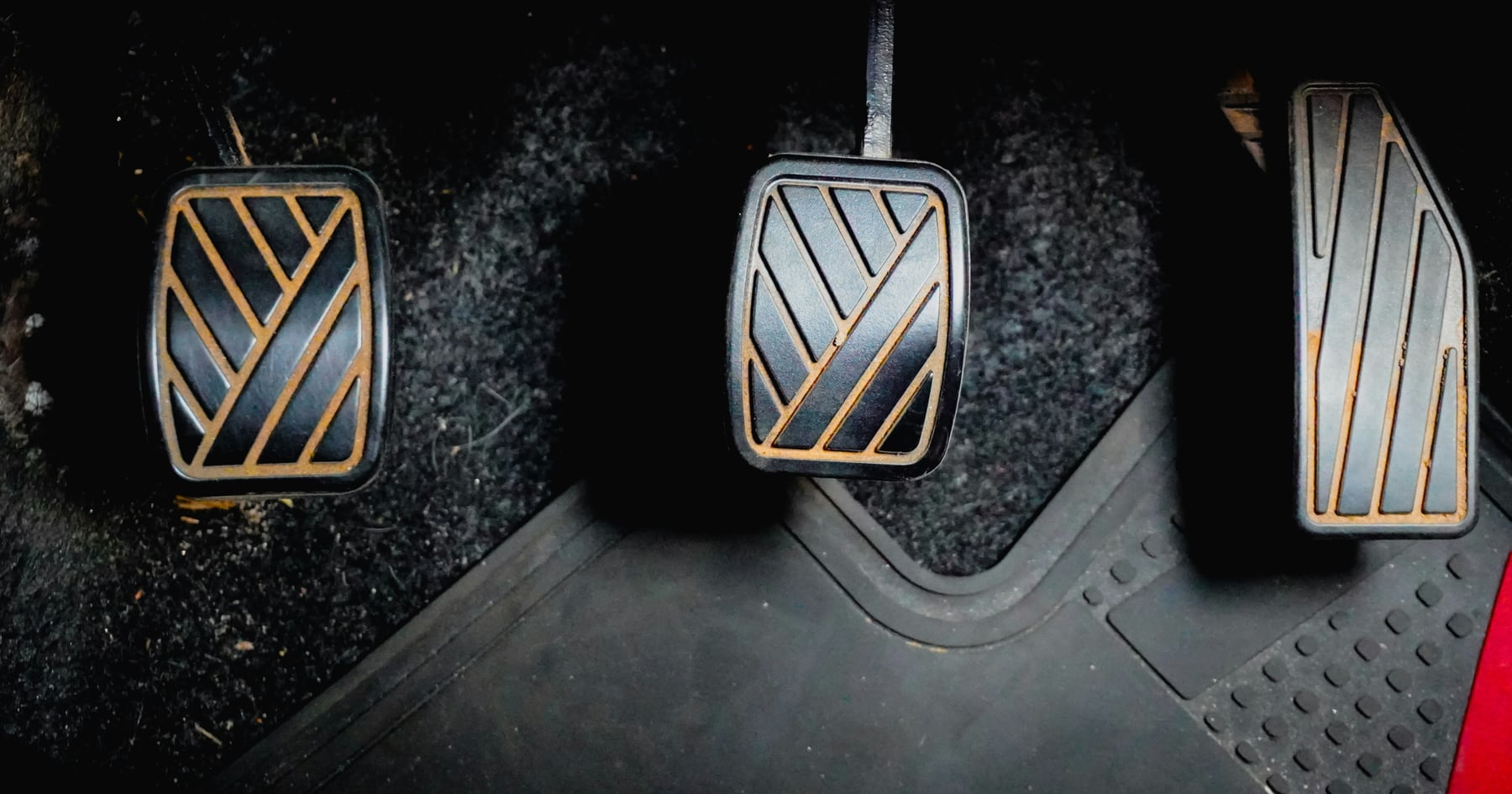
No. Driving barefoot is completely legal in Texas — and in all 50 states. No provision of the Texas Transportation Code says anything about footwear. But if you’re in a wreck, what was on your feet can still come up in your insurance claim. Here’s the myth, the law, and the part that actually matters.
Where the barefoot driving myth came from
Nobody knows exactly where it started. The best guess is that it spread the way most driving folklore spreads — a driver’s-ed instructor repeats it, a chain email forwards it, someone’s uncle mentions it at a family dinner, and forty years later half of Texas believes it’s on the books.
The myth got a real test in the 1990s, when an Illinois man named Jason Heimbaugh wrote to the motor vehicle agency in all 50 states and asked, in writing, whether driving barefoot was against the law. Every state wrote back and said no. That correspondence has been circulating online ever since, and nothing has changed in the decades since he sent it.
The myth is also unusually sticky because it comes with fake specifics. People will tell you it’s a Class C misdemeanor, or that it’s a fifty-dollar fine, or that it’s legal for the driver but not a motorcyclist, or that it’s only illegal if you cause a wreck. None of those are real. They’re the sort of confident detail a story picks up as it gets retold, and the detail is usually what convinces people the story is true in the first place.
You are not the first person to wonder. Texas Monthly and the Austin American-Statesman have both taken a run at this question and landed where we’re about to land: it’s legal, it always has been, and the ticket you’re worried about doesn’t exist.
What those write-ups don’t cover is the part that shows up in our office. Reporters can tell you the law. They can’t tell you what an insurance adjuster does with your flip-flops after a collision. That’s the second half of this article, and it’s the half that costs people money.
What Texas law actually says about driving barefoot: nothing
That’s not a figure of speech. There is no footwear provision anywhere in the Texas Transportation Code. No minimum sole thickness, no prohibition on sandals, no shoe requirement for drivers of passenger vehicles. The subject simply is not addressed.
That absence matters more than people realize, and here’s why.
No statute means no negligence per se. In Texas, when a driver violates a safety statute written to protect the class of people they injured, a court can treat that violation as negligence in itself — nobody has to argue about whether a reasonable driver would have done it. That doctrine is called negligence per se, and it is one of the most useful tools in a car accident case. Running a red light is negligence per se. Driving drunk is negligence per se. Driving barefoot is not, and cannot be, because there is no law to violate.
So what can get you cited? The driving, not the footwear.
Under Tex. Transp. Code §545.401, reckless driving means operating a vehicle “in wilful or wanton disregard for the safety of persons or property.” That is a genuinely high bar. It is not ordinary carelessness and it is certainly not a poor choice of shoes — it is conscious indifference to a known risk. Bare feet, standing alone, have never satisfied that standard and won’t.
The other statute officers actually write is failure to control speed: driving faster than is reasonable and prudent for the conditions in front of you. If bare feet ever produce a citation in Texas, this is the mechanism — not the feet, but a rear-end collision or a late stop that the officer charges as a speed-control violation. We’ve written separately about how failure to control speed works in a Texas car accident, because it appears in more Texas crash reports than any other charge.
The distinction is worth holding onto: Texas regulates how you drive. It does not regulate what you wear while you do it.
That’s also where most of the confusion starts. People hear “it’s legal” and assume the subject is closed — that if there’s no law against it, it can never be held against them. Those are two different questions with two different answers. Criminal and traffic law asks whether the state can punish you. Civil law, the law that governs your injury claim, asks something much broader: whether you acted reasonably under the circumstances, and whether anything you did helped cause the collision. An insurance carrier litigates the second question, not the first. That’s why “there’s no law against it” is a complete answer to the ticket question and only a partial answer to the claim question.
Is driving barefoot illegal in any state?
No. Not one.
Driving barefoot is legal in all 50 states for passenger vehicles. A handful of state agencies discourage it in their driver’s handbooks or safety materials — that’s advice, not law, and no officer can write you a ticket for ignoring it. Footwear requirements do turn up in a few states’ motorcycle equipment rules, but that’s a different vehicle class and a different analysis entirely.
So if your cousin swears he got a ticket for it in Oklahoma, ask to see the citation. What he almost certainly got was a ticket for something else — following too closely, unsafe speed, failure to control — where the officer’s narrative happened to mention bare feet. That is a very different thing from a footwear law, and the difference is the whole point of this article.
The part that matters: what happens after a crash
Here is where a lawyer’s version of this article earns its keep, because this is the question that actually walks into our office. Not “will I get a ticket.” It’s “the adjuster keeps asking what I had on my feet, and I don’t understand why.”
You should understand why.
Adjusters look for anything that shifts fault
Once liability looks bad for their driver, an insurance company’s job is to move some percentage of the blame onto you. Every point of fault they hang on you is a point they don’t have to pay. Footwear is a classic reach — it sounds plausible to a jury, it’s easy to ask about, and most people answer the question honestly and at length without ever understanding what it’s for.
Texas modified comparative fault and the 50% cliff
Texas follows modified comparative fault under Tex. Civ. Prac. & Rem. Code §33.001. Two things follow from it:
- If you are found more than 50% responsible for the crash, you recover nothing. Not a reduced amount — nothing.
- If you are 50% or less responsible, you still recover, but your recovery is reduced by your percentage of fault.
That’s the whole game, and it’s how fault is divided in Texas crashes in every case we handle. It’s also why a carrier will spend real effort trying to move you from 20% to 51%.
Work it through without attaching any numbers to it. Suppose a jury hears the footwear argument and puts 15% of the responsibility on you. Your recovery drops by 15% — whatever the figure would have been, you keep 85 cents of every dollar of it. Now suppose the argument lands harder and the jury puts you at 55%. You take home nothing at all. The same set of facts, argued well or argued badly, is the difference between most of your case and none of it.
Footwear only counts if they can prove causation
Here’s the part carriers would rather you didn’t know: “flip-flops are unsafe” is not evidence. It’s an opinion, and standing alone it proves nothing about your crash.
To move your fault percentage using footwear, the other side has to prove causation — that the footwear actually contributed to this collision. Concretely, they need to show something like a sandal strap catching under the brake pedal, or a bare foot sliding off the pedal face, and that this is why the vehicle did what it did. Proving that takes evidence:
- Pedal and floorboard inspection — is there a sandal wedged under the brake, scuffing on the pedal pad, anything physical to point at?
- Event data recorder download — the black box shows whether the brake was applied, when, and how hard. A full, timely brake application is difficult to square with a foot that supposedly slipped.
- Video — dashcam, traffic camera, or nearby business footage showing the actual sequence.
- Testimony — your own statement, which is exactly why adjusters ask about your feet early, casually, and in a friendly tone.
Take away that chain and all they have left is a stereotype about sandals. Our job is to make them prove it or drop it.
What to say to an adjuster about your footwear
Short version: answer what’s actually asked, and don’t do their work for them.
- Don’t volunteer it. If nobody asks what was on your feet, it isn’t part of the conversation.
- Don’t speculate about causes. “I guess my foot could have slipped” is not a memory, it’s a guess — and it will be read back to you later as an admission. If you don’t know, say you don’t know.
- Don’t give a recorded statement about the mechanics of the crash before you’ve talked to a lawyer. You are not required to.
- Do report the wreck and preserve the paperwork. If law enforcement never came out to your crash, read our explainer on the Texas blue form and what to file after a crash — the reporting rules changed years ago and a lot of people are still following outdated advice.
None of this is about hiding anything. It’s about not handing a carrier a fault argument it would otherwise have to build on its own.
Ironically, barefoot may beat flip-flops
If the goal is actually keeping control of the pedals — rather than avoiding a ticket that doesn’t exist — bare feet are not the worst option on the list.
The footwear that causes pedal problems is footwear that moves independently of your foot or changes the geometry of your ankle: loose sandals and flip-flops that can slide off or wedge under a pedal, high heels that pivot your foot away from the pedal face, thick or heavy boots that dull your feel for pressure, and bedroom slippers that manage to do all three. A bare foot doesn’t come off, doesn’t get caught, and gives you direct feedback on the pedal.
We’re not going to hand you a statistic here, because there isn’t an honest one. Nobody tracks barefoot driving as a crash cause in any systematic way, and anyone quoting you a precise number is either making it up or repeating someone who did. What we can tell you is what shows up in real files: when footwear genuinely contributes to a wreck, it is almost always something loose that caught a pedal — not a bare foot.
There is one honest argument on the other side, and it isn’t about pedal control at all: shoes protect your feet in a collision. Footwells crumple, pedals intrude, and glass ends up everywhere. A closed shoe is better than a bare foot if the front of your car comes back at you. That’s a real consideration — it just has nothing to do with whether barefoot driving is legal, and nothing to do with whether you caused the wreck. It’s an argument for wearing shoes, not an argument the other side can use to reduce what they owe you.
So the practical answer, if you drive in sandals through a Texas summer, is the simple one. Keep a pair of driving shoes in the car, or drive barefoot. Both beat hoping the flip-flop stays put.
Talk to a Fort Worth car accident lawyer
Driving barefoot is legal, and what was on your feet is not, by itself, going to sink your claim. But an adjuster who gets you talking about it without a lawyer in the room can turn it into a fault percentage — and in Texas, fault percentages are money.
If you’ve been hurt in a crash and an insurance company is asking questions that feel like they’re building a case against you, it’s because they may well be. Patterson Law Group offers a free consultation, and we don’t charge a fee unless we win. Call (817) 784-2000.