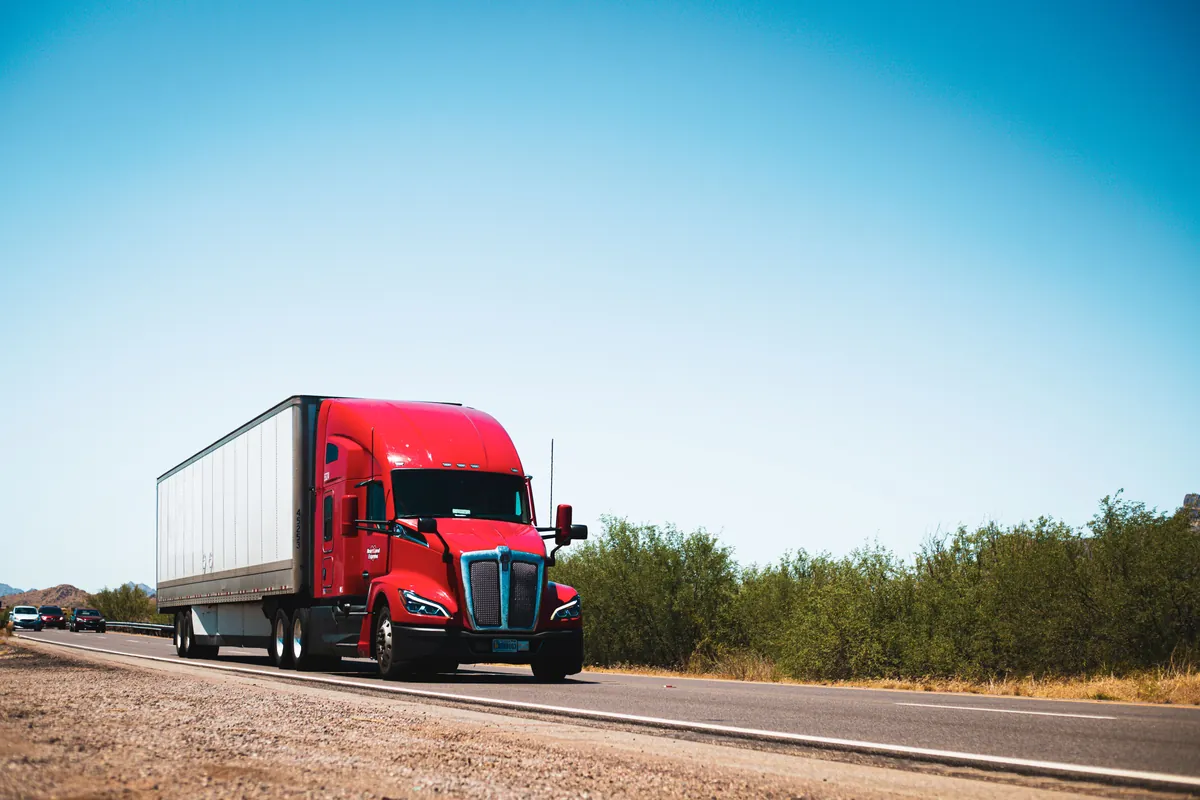
People assume a truck accident is just a car accident with more damage. It isn’t. From the moment an 18-wheeler crashes on I-35W, I-30, or Loop 820, you are in a different legal fight — one with federal rules, a corporate defendant that lawyers up within hours, and far more money on the table. If you treat it like a fender-bender, you lose. Here is what actually changes when a commercial truck is involved, and why it matters for what you recover.
Federal law is in play, not just Texas law
A regular car wreck is governed by Texas negligence law. A commercial truck crash adds an entire federal rulebook on top of it: the Federal Motor Carrier Safety Regulations, enforced by the FMCSA. Those rules dictate how long a driver can be behind the wheel, how the truck has to be inspected and maintained, how cargo must be secured, and how the company has to screen and train the people it puts on the road.
That matters because every one of those rules is a potential violation you can prove. Hours-of-service logs, maintenance records, driver qualification files, drug-and-alcohol testing histories — these are required by federal law, which means they exist, and which means a good lawyer can demand them. A speeding ticket in a car case is one fact. A trucking company that pushed a fatigued driver past his legal hours is a pattern, and patterns move cases.
There is more than one party to hold responsible
In a typical car accident, you have one defendant: the other driver. In a truck case, liability usually spreads across several pockets. The driver may be at fault, but so may the motor carrier that employed him, the company that owned the trailer, the outfit responsible for loading the cargo, the maintenance contractor — and, increasingly, the freight broker that put an unsafe carrier on the road in the first place.
That last one got a lot bigger in 2026. In Montgomery v. Caribe Transport II, the U.S. Supreme Court held that federal law does not shield freight brokers from state negligence claims tied to highway safety — the FAAAA’s preemption does not reach a claim that a broker negligently hired an unsafe carrier, because states keep their authority to regulate motor-vehicle safety. In plain terms: brokers can now be sued in Texas courts for negligently putting a dangerous carrier on the road. We broke down what that means for Texas victims in our analysis of the broker liability ruling. The takeaway for you is simple — more defendants means more available insurance, and more available insurance means a real shot at full compensation instead of a policy that runs dry.
The insurance is bigger — and so is the fight over it
A standard Texas auto policy can carry as little as the state’s 30/60/25 minimum — $30,000 per injured person. Most interstate trucks hauling general freight are federally required to carry at least $750,000 in liability coverage, and many carry $1 million or more. That gap matters: a serious truck wreck — a traumatic brain injury, a spinal injury — can generate medical bills and lifetime care costs that blow past both the at-fault driver’s auto policy and the carrier’s minimum, which is exactly why every layer of coverage and every responsible party has to be found. That much exposure also explains why these cases are fought so hard.
When that much money is exposed, the trucking company’s insurer does not wait around. They send a rapid-response team to the scene, sometimes within hours, to start building a defense before you have even left the hospital. Their job is to minimize what they pay. Texas law gives injured people real leverage here — the Stowers doctrine, which we explain in our guide to Texas Stowers demands. A properly structured settlement demand within the policy limits means that if the insurer unreasonably refuses to accept it and a later verdict exceeds those limits, the carrier can be on the hook for the full judgment — not just the policy limits.
Critical evidence disappears fast
This is the difference that costs people the most. In a car wreck, the key evidence is often still there days later — the damage, the police report, the witnesses. In a truck case, the most valuable evidence is controlled by the company you are suing, and a lot of it is designed to be overwritten.
Modern trucks carry electronic logging devices and event data recorders — the truck’s “black box” — that capture speed, braking, and hours of operation in the seconds before a crash. Federal rules require carriers to keep the official electronic logging records for only six months, and the device-level black-box data can be overwritten within days if no one preserves it. Dashcam footage gets recorded over. Once a company knows a claim is coming, the clock starts on how long that data survives.
That is why one of the first things a Fort Worth truck accident lawyer does is send a spoliation letter — a formal legal demand that the carrier preserve every record tied to the crash. Send it too late and the evidence that would have won your case is simply gone. This single step is the clearest reason not to wait, and not to handle a truck case the way you would handle a car claim.
The injuries — and the stakes — are more serious
A fully loaded tractor-trailer can legally weigh up to 80,000 pounds on most interstate routes. A passenger car weighs roughly 3,500 to 4,000 pounds. Physics does the rest. Truck crashes produce a far higher share of catastrophic and fatal injuries: traumatic brain injuries, spinal damage, amputations, and wrongful death. Those are lifelong consequences with lifelong costs — future medical care, lost earning capacity, and the kind of damages that require expert testimony to prove and protect.
Because the stakes are that high, the defense is that aggressive. The other side will argue you were partly at fault, that your injuries predated the crash, or that your treatment was excessive. Meeting that requires the right experts, the right evidence, and a lawyer who tries these cases rather than just settling them cheap.
What to do if an 18-wheeler hit you
Get medical care first and keep every record. Do not give a recorded statement to the trucking company’s insurer. Photograph everything you safely can. And talk to a lawyer quickly — not because it is the law firm’s preference, but because the evidence that proves these cases has a shelf life.
At Patterson Law Group, our Fort Worth truck accident lawyers move fast to preserve the data, identify every responsible party, and put the full weight of federal trucking law behind your claim. The consultation is free, and you pay nothing unless we win.
If a commercial truck crash turned your life upside down, do not let the company that caused it control the evidence and the timeline. Call us today.