By Travis Patterson, Managing Partner
Updated September 2026
Most stop sign crashes come down to one question: who was supposed to wait? Texas law answers it. The answer decides whose insurance pays and whether you can recover anything at all.
Here is how the rules work, how fault gets proven after the crash, and what to do if you were hit by a driver who blew through a stop sign in Fort Worth or anywhere else in Texas.
What does Texas law require at a stop sign?
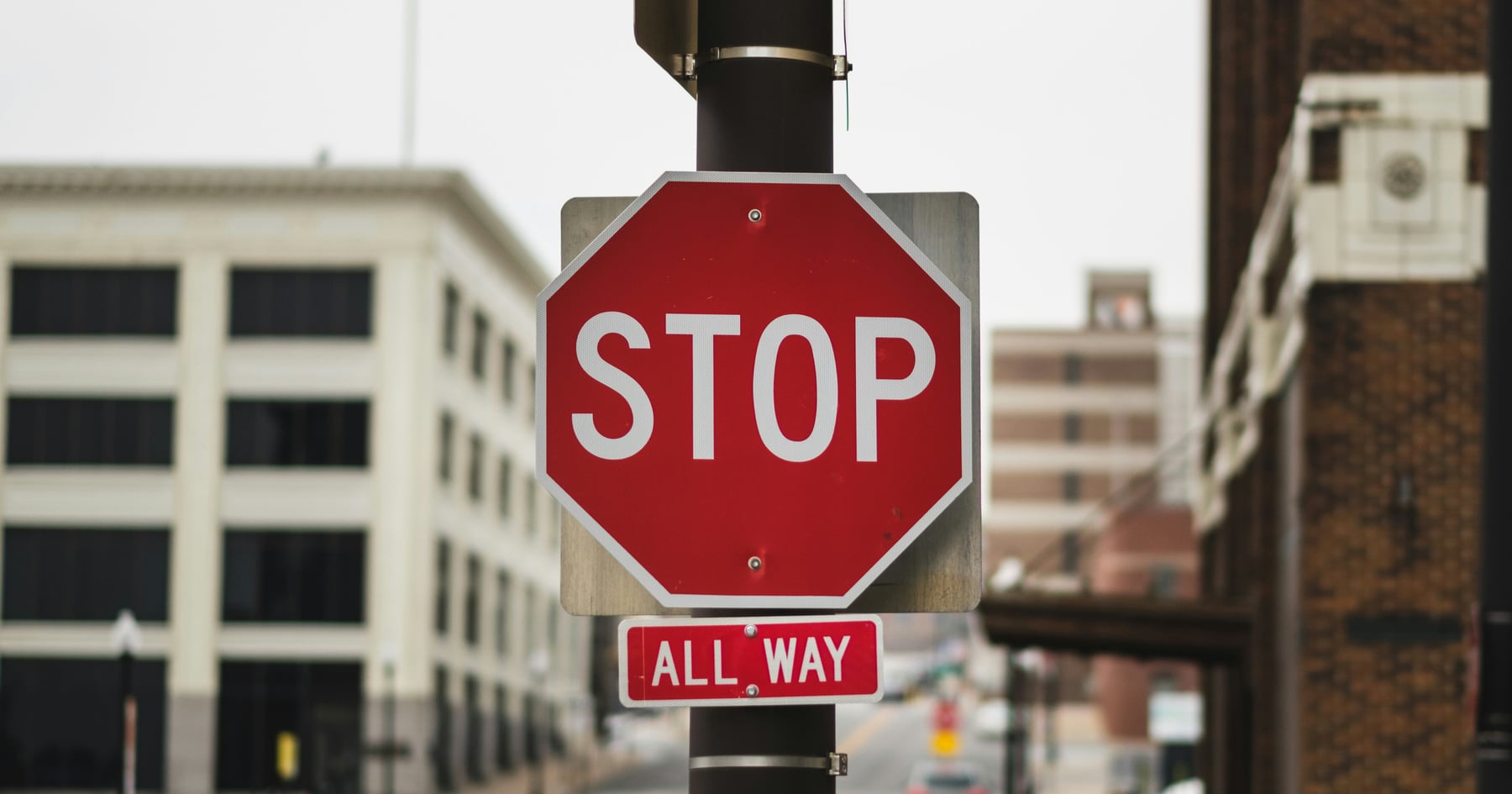
Under Texas Transportation Code Section 544.010, a driver facing a stop sign must come to a complete stop. The stop happens at the marked stop line. If there is no stop line, the driver stops before the crosswalk. If there is no crosswalk either, the driver stops at the point closest to the intersecting road where they can see approaching traffic.
Stopping is only half of it. Under Section 545.153, after stopping, the driver has to yield the right of way to any vehicle that has already entered the intersection or is approaching so closely that it is an immediate hazard. A rolling stop, or a full stop followed by pulling out in front of cross traffic, both break the rule.
Who goes first at a four-way stop in Texas?
The Texas Driver Handbook says the vehicle that arrives first goes first. If two vehicles arrive at the same time, yield to the vehicle on your right.
That is guidance, not the statute itself. The law that governs an all-way stop is the same Section 545.153 duty: after you stop, you yield to anyone already in the intersection or close enough to be an immediate hazard. In a crash case, the handbook rule is still strong evidence of what a careful driver does.
Turning left adds one more rule. Under Section 545.152, a driver turning left has to yield to an oncoming vehicle that is already in the intersection or close enough to be an immediate hazard.
Who has the right of way at a two-way stop?
At a two-way stop, cross traffic without a stop sign does not stop. The driver at the stop sign has to yield to that traffic and wait until it is safe to go. Many of the most serious stop sign crashes happen here. The through driver is often traveling at full speed and the result is a T-bone collision, which puts the impact right at the driver’s or passenger’s door. (We covered why those crashes are so dangerous in What Is the Survival Rate for T-Bone Accidents?)
Who is at fault in a stop sign accident?
Usually the driver who had the stop sign and failed to stop or failed to yield. But the insurance company will not concede that without a fight. Common arguments we see:
- “I stopped, then the other car came out of nowhere.” This is the most common defense. It turns on sight lines, speed, and timing.
- “The other driver was speeding.” If the through driver was going well over the limit, the insurer will argue they share the blame.
- “The sign was blocked or missing.” Overgrown trees or a missing or knocked-down sign can shift part of the blame. A Texas city can sometimes be held responsible for a missing or damaged sign, but only in narrow situations, usually where it had notice of the problem and failed to fix it within a reasonable time.
- “We both stopped at the same time.” At four-way stops, fault often comes down to who arrived first and who was on the right.
How does shared fault affect my claim in Texas?
Texas follows a modified comparative fault rule, sometimes called the 51% bar. A jury or insurer assigns each driver a percentage of responsibility. Your recovery is reduced by your percentage. If you are found more than 50% responsible, you recover nothing.
So if you were 20% at fault for speeding through the intersection and the other driver was 80% at fault for running the stop sign, a $100,000 claim becomes $80,000. That is exactly why the other driver’s insurer will look for any reason to push part of the blame onto you.
What evidence proves the other driver ran the stop sign?
Stop sign cases are often one driver’s word against the other’s. The cases that settle well are the ones with evidence that doesn’t depend on memory:
- Video. Doorbell cameras, business security cameras, and dashcams. Many camera systems record over old footage automatically, so ask for it right away.
- Witnesses. Independent witnesses carry weight because they have no stake in the outcome. Get names and phone numbers at the scene.
- Vehicle damage. Where the cars were hit tells a story. Damage to the side of your car and the front of theirs fits a failure-to-yield crash.
- Event data recorders. Most new vehicles have one. It can store speed and braking data from the seconds around a crash.
- The crash report. In Texas, an officer who investigates a crash involving injury, death, or at least $1,000 in apparent property damage must file a written report (form CR-3). The report codes contributing factors, including “Disregard Stop Sign or Light” and “Failed to Yield ROW - Stop Sign.” That is the officer’s opinion, not a ruling on fault. A traffic ticket is generally not admissible in the injury case, but it tells you how the officer saw the crash.
- Photos of the intersection. The sign, the stop line, trees or parked vehicles blocking the view, and skid marks.
What should I do after a stop sign crash in Fort Worth?
- Call 911 and get medical care. Some injuries, especially to the neck, back, and head, may not show up for hours or days.
- Photograph both vehicles, the stop sign, and the intersection from every approach.
- Get witness names and numbers before they leave.
- Look around for cameras on homes and businesses and write down the addresses.
- Do not give a recorded statement to the other driver’s insurance company before you talk to a lawyer.
- Keep every medical bill, prescription receipt, and record of missed work.
How long do I have to file a claim?
In Texas, the deadline to file a personal injury lawsuit is generally two years from the date of the crash. Waiting that long is a mistake in a stop sign case, though. The video and witnesses that prove who had the right of way disappear much faster than the deadline.
Talk to a Fort Worth car accident attorney
If you were hurt by a driver who ran a stop sign or failed to yield, a Fort Worth car accident attorney can get the evidence preserved before it is gone and deal with the insurance company for you. Learn more about how we handle stop sign accident cases, or read how fault works in a rear-end collision in Fort Worth.
Patterson Law Group offers a free consultation, and you pay nothing unless we win. Call (817) 784-2000.